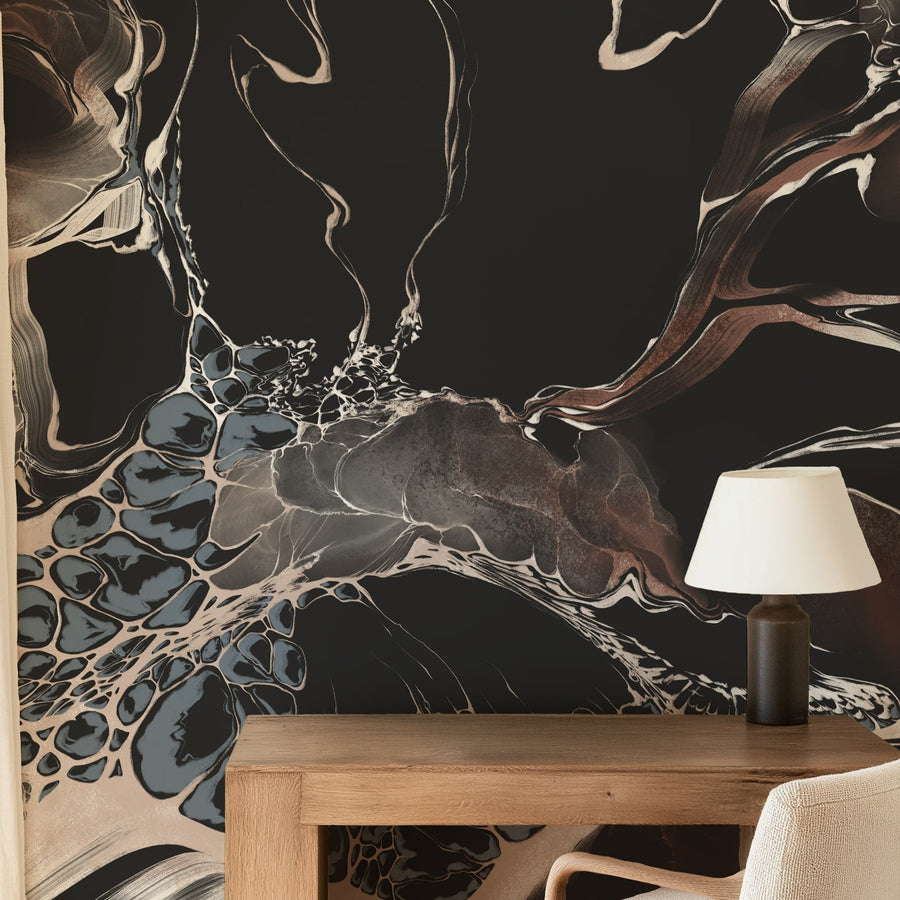
A Range of Floral Wall Murals
Floral wall murals can feel completely different depending on the background color, contrast, painting style, and scale of the blooms. At the dramatic end are peonies, poppies, and roses on deep, near-black backgrounds, where the contrast pulls the eye straight to the blooms and the stronger contrast makes the floral composition more prominent on the wall. At the other end, soft watercolor washes, sakura, and single-line flower designs create a softer, lower-contrast effect, with the flowers reading more as a quiet backdrop than a focal point.
In between sit two traditions worth separating. Vintage botanical murals — sepia, indigo, and fine ink-etched plates — look like enlarged antique botanical illustrations, detailed but low in color, and overlap with our vintage wallpaper collection. Painterly garden and Dutch still-life-inspired florals go the other way, with fuller, layered bouquets and richer color. The watercolor wallpaper collection carries the same soft treatment as repeating patterns if a mural isn't what you need.
Floral Mural vs Repeating Floral Wallpaper
The difference is structural, not decorative. A floral mural is one composition printed across several panels, so the bouquet or branch appears once at full size and reads as a single piece of wall art. Repeating floral wallpaper carries the same motif over and over, which continues from panel to panel across multiple walls and around corners.
That makes the choice fairly practical. A mural makes sense when you want one wall to carry a large floral composition; a repeat is more flexible when you are covering several walls or wrapping around corners. For repeating floral patterns, see the floral wallpaper collection. Chinoiserie florals — cranes, blossoms, and hand-painted garden scenes — are included in our chinoiserie collection.
Scale, Cropping, and Where the Flowers Land
A flower printed at mural scale behaves differently than the same flower in a small repeat. From across the room, the overall shape and balance of the composition become more apparent; closer to the wall, individual petals, linework, and painted details come forward. Before choosing, it helps to decide which bloom is the focal point and where it will sit on the wall.
Furniture is the main thing to plan around. Because the composition is continuous, a headboard, dresser, or sofa will cover whatever part of the scene sits behind it, so measure the full wall — width and height, including the area behind furniture — and check where the key flowers fall relative to what will stand in front of them. Once the mural is sized and produced, the position of each bloom is set, so it is worth marking furniture height on the wall before ordering.
Each mural is printed as one composition and then divided into standard panels, with the number of panels set by your wall's width — a 12-foot wide wall arrives in six panels. EazzyWalls offers standard mural sizes, with custom sizing available when the artwork needs to fit a specific wall; send us the full wall width and height to match the size to your space.
Color, Light, and Material Choice
Background color and contrast have a major effect on how a floral mural reads in the room. Deep, dark-ground designs carry visual weight and make the wall prominent, while pale watercolor and neutral botanical designs keep it quieter. Because printed color can look different from a screen, order a sample and check the dominant tones from where you will actually stand in the room, in both daylight and evening light, against your furniture and finishes.
Every design in this collection is available in all of our material options. Peel and stick is self-adhesive and installs on a smooth, clean, properly painted, fully cured wall; it comes in Smooth Vinyl, with a semi-gloss finish, and Canvas, with a matte woven texture, both removable. For newly painted walls, EazzyWalls currently recommends allowing at least eight weeks to cure before installation.
Traditional Type II is paste-installed and commercial-grade, handles slight wall texture that peel and stick does not, and is Class A / Class 1 fire rated (ASTM E84). For a restaurant, hotel, or other commercial install, confirm the project's own fire and building requirements before specifying a material; the commercial wallpaper collection covers those uses.