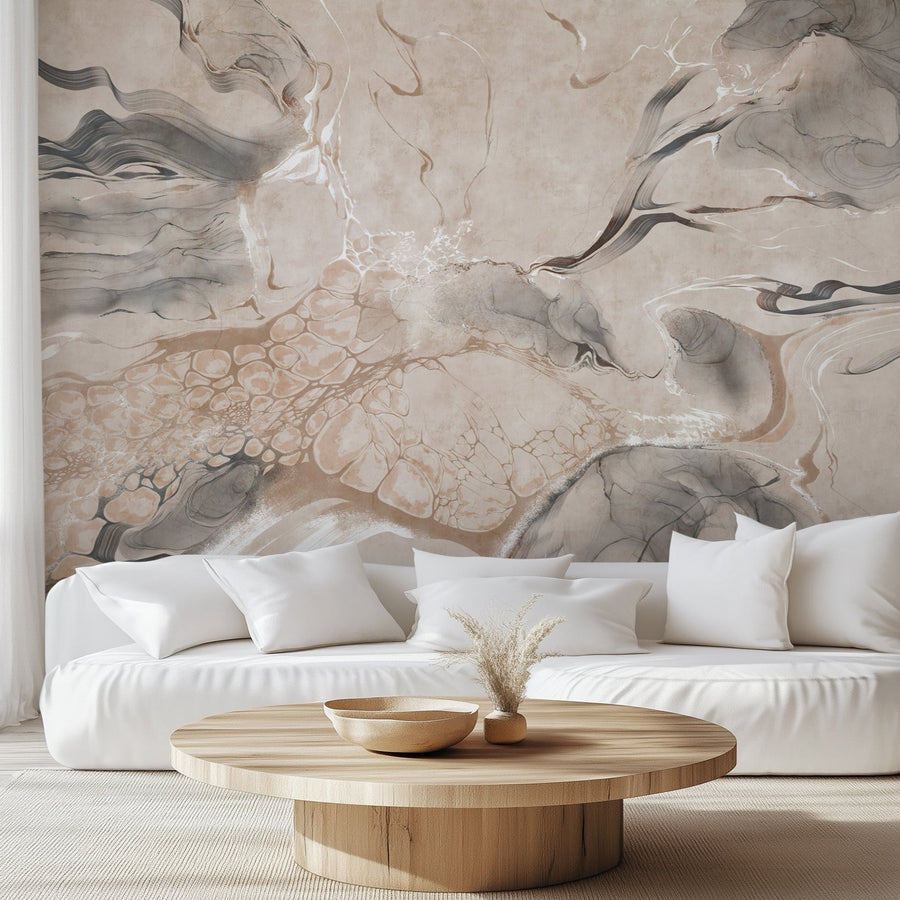
Look up in almost any room and you'll find the one surface decorating usually forgets. Designers call it the fifth wall, and it may be the highest-impact, lowest-traffic place in the house to install a ceiling wallpaper — a quiet way to make a room feel finished, considered, and genuinely memorable.
Ceiling wallpaper is wallcovering applied overhead to the "fifth wall" rather than the vertical walls. Designers use it to draw the eye upward, add an atmosphere, and turn an overlooked surface into a focal point — most often with sky and cloud scenes, botanicals, soft geometrics, or a dark, enveloping pattern. As a wallcovering manufacturer, we produce ceiling wallpaper designs every week, so this guide goes past the inspiration photos into what actually works: which patterns read well from below, how scale and color change on a ceiling, which material to choose, and how to install it without fighting gravity. Browse the full ceiling wallpaper collection as you read.
Key Takeaways
- The ceiling is the "fifth wall" — an overlooked surface worth treating as part of the design.
- Judge pattern scale from floor level and against the whole ceiling — a big, open motif can suit a broad ceiling, while a small, dense, high-contrast repeat can read as busy overhead.
- Non-directional and random patterns (clouds, florals, geometrics) read best overhead; strongly directional designs need planning.
- Bedrooms, nurseries, dining rooms, powder rooms, and nooks are among the most natural places to start.
- It needs a smooth, primed surface.
- Order a sample first — a pattern reads differently flat overhead than it does upright on a screen.
In this guide
- What Is Ceiling Wallpaper (the "Fifth Wall")?
- Why Put Wallpaper on the Ceiling?
- Best Ceiling Wallpaper Designs
- Creative Ways to Use Ceiling Wallpaper
- Best Rooms for Ceiling Wallpaper
- How to Choose Ceiling Wallpaper
- Mural vs. Repeating Pattern
- Materials & Textured Ceilings
- How to Measure a Ceiling
- How to Prep & Install
- Common Mistakes to Avoid
- FAQ
What Is Ceiling Wallpaper (the "Fifth Wall")?
Ceiling wallpaper is simply wallcovering installed on the ceiling instead of — or in addition to — the vertical walls. The ceiling earns the nickname "fifth wall" because it's the fifth major surface in almost every room, equal in size to a wall but routinely left plain white. Treating it as a design surface rather than an afterthought is one of the oldest tricks in decorating, and it has come back strongly as part of the move toward warmer, more enveloping, maximalist rooms.
Part of the appeal is that a ceiling usually offers a larger uninterrupted field than a wall — no doors, no low windows, no furniture pushed against it — so a wallpaper design can often run across it more cleanly. It's rarely a completely blank canvas, though: your layout may still need to work around recessed lights, a chandelier or fan, a smoke detector, sprinklers, speakers, skylights, beams, or a tray or coffer. None of those rule out wallpaper; they just shape where panels fall, so map them before you plan. Either way, a wallpapered ceiling reads as a deliberate, considered choice, because it's the one surface guests don't expect to see decorated.
Why Put Wallpaper on the Ceiling?
Beyond the surprise factor, there are practical reasons designers reach for the ceiling:
- It draws attention upward and reshapes how a room reads. A ceiling wallpaper pulls the eye up and changes how the room's proportions are perceived. Light, open designs tend to emphasize airiness; darker or denser ones make a room feel more intimate and enclosed. The effect depends on ceiling height, lighting, color, contrast, and pattern density.
- It rescues small rooms. In a powder room, nook, or small bedroom where the walls are already taken up by fixtures, cabinetry, or windows, the ceiling is often the only large surface left to decorate.
- It creates an "envelope." Wrapping pattern or color overhead makes a space feel cocooning and finished rather than flat.
- It tends to last. A ceiling takes no hand contact, no furniture scuffs, and far less direct sunlight than a wall, so an overhead install generally stays looking new longer.
- It's low-commitment project. One wallpapered surface delivers a big visual payoff, and in a removable wallpaper material you can change your design later, without damaging the surface.
Best Ceiling Wallpaper Designs
Not every design that looks good on a wall works overhead. The wallpaper selections below are the ones we see succeed most often on a ceiling, with a note on why each works and where to use it.
Cloud Ceiling Wallpaper Mural
If you try one thing on a ceiling, make it sky. A cloud wall mural feels especially natural overhead because it mirrors the view we associate with looking up, which makes it an easy, low-risk way into the fifth wall. It's calming above a bed, dining table and a quiet bit of magic in a nursery.

Starry Night Ceiling Wallpaper
Distinct from a daytime sky, a star or constellation pattern turns a ceiling into a night sky — which is why it's a nursery, kids room, and bedroom favorite, giving you something to look at from the crib or the pillow. In a deep navy or charcoal ground with metallic-look stars, the same idea grows up into a sophisticated dining room or powder room.

Botanical & Tropical Ceiling Wallpaper
Leaves and branches overhead read like a canopy seen from below, which is a naturally restful thing to look up into. Botanical and tropical palm designs are a prominent ceiling look, well suited to sunrooms, bedrooms, and kitchens, and because foliage patterns are usually random rather than strongly one-directional, they're forgiving to align. Explore botanical and tropical designs.

Ceiling Wallpaper Mural
Beyond sky and foliage, a scenic wall mural — a forest canopy, abstract marble, a chinoiserie scene of branches and birds — turns the whole ceiling into a single piece of art. Because it's one continuous image sized to your ceiling, it reads as bespoke, and the climbing lines of a chinoiserie or landscape scene draw the eye across the surface. It's a jewel-box move for a living room, an entry room, or a romantic bedroom. Browse wallpaper murals.

Dark Floral Ceiling Wallpaper
A large-scale dark floral wallpaper is a confident, atmospheric choice. Against a deep ground the blooms read as rich and enveloping, which suits a dining room, powder room, or a bedroom you want to feel cozy. The effect depends on the room: with reasonable ceiling height, good light, and calm walls, a dark floral adds depth; in a low or dim room the same design reads heavier and more intimate, so choose it with the room in mind. Keep the walls quiet and let the ceiling lead. See more floral designs.

Geometric & Abstract Ceiling Wallpaper
Geometric wallpaper designs are consistent winners overhead for one simple reason: a symmetrical, non-directional repeat looks correct from every doorway and every seat in the room, so there's no single "right way up." Clean geometric and organic-abstract patterns suit modern kitchens, offices, and living rooms where you want structure without fuss. Browse geometric wallpaper.

Stripes Ceiling Wallpaper
Stripes are one of the clearest ceiling wallpaper patterns — they draw the eye along their length, so you can use direction deliberately to make a room feel longer or wider. A soft tonal stripe keeps the effect subtle; a bolder one turns the ceiling into a graphic statement.

Art Deco Ceiling Wallpaper
Art Deco is a natural fit overhead: its fans, sunbursts, and symmetrical geometry are built around a radiating center, which reads beautifully on a ceiling around a central light or medallion. In gold against deep green or black it brings a glamorous, jewel-box quality to a dining room, powder room, or bar area. Explore Art Deco wallpaper.

Vintage & Heritage Ceiling Wallpaper
Heritage patterns — toile, damask, and William Morris-style botanicals — bring a collected, old-world sensibility to a ceiling, and their dense, all-over repeats suit the fifth wall especially well because there's no single orientation to get wrong. They're a classic choice for a formal dining room, a study, or a traditional bedroom. See our vintage and William Morris-style designs.

Modern Ceiling Wallpaper
Modern ceiling wallpaper works especially well with geometric patterns, where repetition brings movement and structure without relying on florals or traditional ornament. In this room, the warm neutral mid-century pattern continues from the walls across the ceiling, creating a more immersive, cohesive effect and softening the visual break between vertical and overhead surfaces. The graphic repeat is bold, but the restrained palette keeps it balanced with the room's clean-lined furniture and statement lighting. Browse modern wallpaper.

Creative Ways to Use Ceiling Wallpaper
Beyond a single statement ceiling, a few approaches use the fifth wall to solve a specific design problem.
Wall-to-Ceiling Wallpaper
Running the same wallpaper design from the walls straight up and across the ceiling erases the line where the wall stops, which cocoons the room in a single, immersive pattern. It's a dramatic option and works beautifully in small, enclosed spaces — a powder room, an attic bedroom, a reading nook — where that wrapped effect feels intentional rather than overwhelming.
Sloped Ceiling Wallpaper Ideas for Attics & Nooks
Don't fight an awkward ceiling — wallpaper it. In attic rooms, eaves, and other sloped spaces, carrying one pattern across the angles helps the architecture feel intentional rather than difficult to work around. A well-scaled, lower-contrast design can keep the effect calm and cohesive, while a continuous pattern flowing over the slopes creates a more finished, enveloping look than treating each plane separately.
Ceiling Wallpaper for Coffered & Tray
If your ceiling already has architecture — a tray, a coffer, beams — use the wallpaper to fill only the recessed panels. Wallpaper inside the frame creates a tailored, frame-within-frame effect and is a lower-commitment way to test an overhead pattern before you commit to the whole surface.
Best Rooms for Ceiling Wallpaper
A wallpapered ceiling can work beautifully in nearly any room, but some spaces lend themselves to it especially well.
- Bedroom. A natural fit, because you actually lie down and look up. A calm sky, a soft botanical, or a moody floral above the bed is the last thing you see at night and the first in the morning. Pair with our bedroom wallpaper.
- Nursery & kids' rooms. Clouds, stars, and animals give a child something to look at from the crib, and our wallpaper designs are made with water-based, GREENGUARD Gold-certified inks. See our nursery wallpaper.
- Dining room. A room you light for atmosphere and view while seated — ideal for a dramatic dark floral, chinoiserie, or a metallic-look pattern that catches the chandelier. Explore dining room wallpaper.
- Powder room. Small, low-stakes, and used briefly, a powder room is a great place to be bold overhead — and with no shower or tub, humidity is generally lower than in a full bathroom, so the ceiling is an easy surface to paper.
- Living room. Subtle textures and tonal patterns add sophistication without stealing focus; let the furniture and art lead and the ceiling support. See living room wallpaper.
- Entryway & hallway. A wallpapered ceiling in the first space guests see sets the tone for the whole home and makes a narrow hall feel intentional.
- Home office. Wrapping a small study in pattern overhead adds energy and warmth to a room you spend focused hours in.
- Bathroom. Suitable in a full bath with good ventilation, using a washable, moisture-tolerant material kept away from direct shower spray. For steamy rooms our heavier, paste-installed Traditional Type II is the more durable choice; see the bathroom wallpaper. No wallpaper should be treated as a direct-water-exposure surface unless it's specifically designed for it.
How to Choose Ceiling Wallpaper
Choosing wallpaper for a ceiling is not the same as choosing for a wall. A few factors change the decision.
Ceiling height
Height drives color more than anything. In a low room, lean toward lighter, airier designs — pale skies, soft tonals, open patterns — which keep the ceiling feeling high. Save deep, dense, dark patterns for rooms with average-to-tall ceilings, where they add cocooning depth rather than pressing down.
Pattern scale
Assess scale from floor level and in relation to the whole ceiling, not simply by shrinking the design because it's overhead. A large, open motif can look generous on a broad, uninterrupted ceiling, while a small, dense, high-contrast repeat can feel busier up there than it would on a wall. Weigh the ceiling's dimensions, the pattern's density and contrast, the motif and repeat size, the architecture, and how much uninterrupted area you have. A sample taped overhead tells you more than any rule of thumb.
Pattern direction
A ceiling has no obvious "up," so non-directional and symmetrical patterns — clouds, florals, geometrics — are the safest because they look right from every doorway and seat. Strongly directional designs (a one-way motif, a clear stripe) still work, but you have to decide deliberately which way they should run and commit the whole ceiling to it.
Color and natural light
Ceiling wallpaper can look noticeably different overhead because the ceiling receives natural and artificial light from different angles than the walls. Depending on your windows, ceiling fixtures, recessed lighting, the time of day, and the room's orientation, the same color may read lighter, darker, warmer, or cooler than you expect. This is exactly why a sample matters: tape it to the actual ceiling and look at it in daylight and with the lights on before you commit.
Coordinating with walls, furniture, trim & fixtures
The reliable formula is to let the ceiling lead and keep everything else calm: quieter walls, simpler furniture, and the pattern overhead as the star. If you want the walls papered too, either run the same design across both for a seamless envelope, or pair a patterned ceiling with a plain or semi-plain wall in a color pulled from the design. And remember the fixtures — a central light, medallion, or fan becomes part of the composition, so choose a pattern that frames it rather than collides with it.
Ceiling Wallpaper Mural vs. Repeating Pattern
Both can work beautifully overhead, but they create very different effects.
A ceiling wallpaper mural is one continuous composition — such as a cloudscape, forest canopy, or scenic design — produced across numbered panels to fit the ceiling. Each panel still needs to align precisely so the artwork connects cleanly across the seams, but unlike repeating wallpaper, the image is designed to be viewed as one complete scene. Murals work especially well on broad, relatively uninterrupted ceilings where the full composition has room to read.
A repeating wallpaper pattern uses the same motif with a repeat across the surface. Florals, geometrics, stars, stripes, and many botanical designs fall into this category. Because the pattern can continue beyond a single fixed composition, repeats are particularly useful for wall-to-ceiling applications, sloped ceilings, and spaces interrupted by beams, trays, or other architectural details.
As a general guide, choose a mural when you want the ceiling to read as one large-scale artwork, and a repeating pattern when you want continuous coverage that can adapt more easily to the architecture of the room.
Peel & Stick vs. Traditional Wallpaper for Ceilings
We offer peel and stick and traditional type II wallpaper materials for your ceiling project:
- Peel & Stick (removable) — self-adhesive, in Smooth Vinyl (satin) or Canvas (matte woven texture). Browse peel and stick wallpaper.
- Traditional Type II (permanent, paste-installed) — a commercial-grade wallcovering in Traditional Canvas or Faux Grasscloth (other materials available on request). See our Traditional Type II range.
For ceiling installation, neither option is automatically better. Peel & Stick is lighter and avoids the extra step of applying paste, which can make it appealing for smaller DIY projects, but its adhesive begins gripping as soon as the material touches the ceiling surface, so careful initial alignment matters, although the panel can be lifted and repositioned during installation. Avoid pulling or overstretching the material while repositioning, as this can distort the panel and affect seam or pattern alignment. Traditional Type II takes more preparation and is heavier to handle overhead, but the paste provides more working time for positioning and alignment, making it a strong choice for larger ceilings, detailed repeats, and permanent installations.
The right material depends on the ceiling surface, project size, pattern, installation experience, and how permanent you want the finished result to be. All substrate finishes are made to order in USA, printed with water-based, GREENGUARD Gold-certified inks, and samples are available for every design, so you can compare the material, color, and finish before ordering the full project.
Textured ceilings
Surface condition matters more overhead than almost anywhere, because gravity is constantly testing the bond. Our peel & stick materials need a smooth, properly prepared surface; light texture is generally better suited to paste-installed Traditional Type II, which grips varied surfaces more reliably. Popcorn, heavy orange peel, knockdown, flaking paint, or any damaged or unstable surface should be properly prepared first — skim-coated smooth (and popcorn removed) and primed. Wallpaper shouldn't be used to cover up deteriorating or unstable ceiling material; fix the surface first, then wallpaper it.
Manufacturer's Tip
Mind your lighting before you plan panels. A recessed downlight or a window near the ceiling throws its beam straight along the surface, which grazes across any seam or minor imperfection and makes it more visible than the same seam would be on a wall. There's no single right panel direction — plan it with your windows, recessed lights, chandelier, room shape, pattern and artwork orientation, fixtures, and seam placement in mind, so seams fall where they'll be least noticeable. A flat, uniform surface and a textured or tonal pattern both help a seam disappear; a flat solid color shows it most.
How to Measure a Ceiling for Wallpaper
Because every EazzyWalls wallpaper design is made to order and custom-sized, accurate measurements matter. Measure the ceiling's length and width (take the longest and widest points, since rooms are rarely perfectly square). For irregular, angled, or sloped areas, split the ceiling into rectangles and measure each; on slopes, measure along the slope rather than the floor. Note any trays, coffers, or beams and decide which surfaces you're wallpapering, so installation can be planned around them. Decide roll direction before ordering, and allow extra for trimming; murals are sized to your dimensions and arrive as a numbered set with a 1 inch overlap for alignment. If your ceiling is irregular or you're unsure, send us your measurements and images and we'll help size the order.
How to Prep & Install Wallpaper on a Ceiling
Yes, you can wallpaper a ceiling yourself, but it is more demanding than a wall, and for most full-ceiling projects a second person makes the job much easier. The essentials:
- Prep the surface. The ceiling must be smooth, clean, dry, and primed. Fill holes, sand down bumps, and wipe away dust so the adhesive has a ready surface to grip against gravity.
- Plan the whole layout before you hang anything. Your layout depends on what you're installing. For a wall mural, lay the artwork first on the floor, confirm the panel order, and follow the numbered sequence, accounting for key visual elements and fixtures. For a repeating pattern wallpaper, snap a straight reference line, plan where the design falls, and aim for balanced edge cuts at opposite sides — working around fixtures and architecture rather than discovering them mid-install.
- Work with a partner and a stable platform. One person supports the panel while the other smooths; use a sturdy stepladder or scaffold, never an improvised stack.
- Smooth out from the center. Work air bubbles outward with a smoother, panel by panel, and wipe any excess paste promptly (if traditional wallpaper is used).
Full wall-prep and installation instructions are included with every order. For a large or high ceiling, a complex repeat, or a heavier material, hiring a professional installer is often worth it — ceiling wallpaper installation is where experience pays off most.
Common Ceiling Wallpaper Mistakes to Avoid
- Choosing the wrong scale. Judge the pattern from floor level, not just from a close-up sample. A large, open motif can suit a broad ceiling, while a dense, high-contrast repeat may feel busier than expected overhead.
- Ignoring pattern direction. One-way motifs and stripes need to be oriented deliberately so the design looks intentional from the room's main viewpoints.
- Skipping surface prep. Wallpaper adheres best to a smooth, clean, dry, stable, and properly primed ceiling. Texture, dust, loose paint, or uneven areas can affect adhesion and make imperfections more visible.
- Overlooking the lighting. Recessed lights and nearby windows can cast light across the ceiling and make seams or surface irregularities more noticeable, so consider lighting when planning the panel layout.
- Choosing dark wallpaper without considering the room. Deep colors can create a cozy, enveloping effect, but in a low or poorly lit room a dense, high-contrast pattern may feel visually heavier.
- Letting every surface compete. If the ceiling carries a bold pattern, quieter walls and furnishings usually give it more room to work. If you want pattern on both walls and ceiling, coordinate them intentionally rather than treating each surface separately.
- Not ordering a sample. Color, scale, and contrast can look very different overhead. Tape the sample to the ceiling and view it in daylight and artificial light before ordering.